Didier Cossin
Didier Cossin is Chaired Professor of Governance and Finance, and holds the UBS Chair in Banking and Finance. In 2010, he founded the IMD Global Board Center and served as its Director until its leadership transition in 2026.
Cossin is the originator of the Four Pillars of Board Effectiveness methodology and an advocate of stewardship – the idea that leaders should aim to deliver positive long-term social and economic impact.
He is also focused on the governance of investments, including how ESG can be integrated with the investment process all the way through to asset allocations and not only in asset selection and engagement. Good governance transforms performance because it protects against downside risks, such as reputational risks and integrity risks, he says, and helps organizations to adapt, which creates upside opportunities.
Good governance transforms performance because it protects against downside risks such as reputational risks and integrity risks, and helps organizations to adapt, which creates upside opportunities.
At IMD, Cossin leads several signature programs, including High Performance Boards and The Role of the Chair, as well as delivering custom governance programs for organizations around the world.
Cossin defines governance as the art of decision-making at the top of organizations and says better-governed companies outperform their peers because they are better protected against downside risks and more agile and able to profit from upside opportunities.
He favors an adaptive and interactive approach to finding distinctive solutions for organizations based on the social, geopolitical, technological, and economic transformations in different regions of the world. Corporate boards, he says, also need to factor in geopolitical risks, social evolution, and the long-term instability of the world, which is something they often do not give sufficient thought to.
His clinical work has enabled him to identify a number of essential elements for successful governance, which he calls the Four Pillars of Board Effectiveness. These are:
- The quality, diversity, focus, and dedication of people
- Information architecture – internal and external, formal and informal
- Structures and processes
- Group dynamics and board culture
Cossin has worked as an advisor and executive teacher to supranational organizations (United Nations, European Central Bank, World Bank, IFC, International Olympic Committee) and sovereign wealth funds and state investors (PIF in Saudi Arabia, ADQ in Abu Dhabi, Temasek in Singapore), as well as ministries, central banks, wealthy families, and the boards or executive committees of corporations, financial institutions, and funds in Europe, Asia, the Americas, Africa, and the Middle East. He also advises non-profit organizations such as the Red Cross and IUCN (the International Union for Conservation of Nature) on governance. He is currently Senior Advisor in Governance to UNICEF and to the International Organization for Standardization.
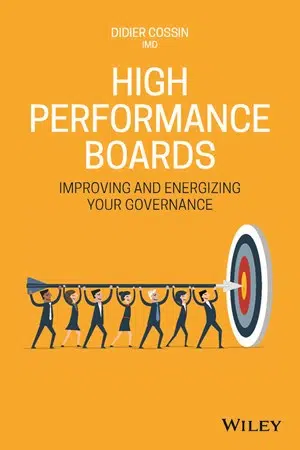
He is the author of two books on governance (Inspiring Stewardship and High Performance Boards) and has published articles in leading journals such as Management Science, the Journal of Banking and Finance, the Journal of Computational Finance, and MIT Sloan Management Review. He is also a columnist for CEOWORLD magazine.
Cossin is President of the Stewardship Institute, whose goal is to support projects with positive social impact through ESG research and advocacy, and Chairman of BERG Capital Management, which manages investment processes for large asset owners using governance principles. He is also a member of the American Finance Association, the Eastern Finance Association, and the European Finance Association.
Before joining IMD, he was Professor of Finance at HEC Lausanne. He previously taught at Harvard University, where he obtained two Derek Bok Awards for excellence in teaching, and was a visiting professor at the University of California and INSEAD.